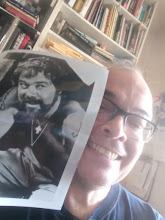
"Mr. Tremble..."
"Trumbull!"
"I said ‘Tremble.’ ”
The Comedy of Terrors (1963)
Directed by Jacques Tourner
Written by Richard Matheson
Produced by Samuel Z. Arkoff & James H. Nicholson
Director of photography: Floyd Crosby
Production design and art direction: Daniel Haller
Cast: Vincent Price, Peter Lorre, Boris Karloff, Basil Rathbone and others
Released by American-International Pictures
83 min.
It was the Day of the Big Snow here in NYC, and after a week of exhausting activities, I had slept for 13 hours (usually I clock 5 hours of log sawing per evening).
When I woke up, I decided to stay in and accomplish something.
Meanwhile, I threw on Jacques (The Cat People) Tourner’s The Comedy of Terrors, written by genre ace Richard Matheson, on the old televizer unit, thinking that the flick would be background noise.
Instead I wound up enthralled.

Give this movie some time, the humor will eventually get quite sick, as Vincent Price
(hilarious as a bitter drunk, with great lines like, “Get up! You’re sitting on my money!”)
and Peter Lorre play down-on-their-luck undertakers in late-1800s New England who resort to homicide to increase their business.

This flick was produced by American-International Pictures (AIP) to capitalize on the success of the Poe/Price series, and was given the green light after Roger Corman’s spoof The Raven, also written by Matheson, was a hit.
(And The National Film Board of Ivanlandia have been a big fan of Corman’s The Raven since we first viewed it on the old ABC-TV 4:30 Movie about a million years ago—
it’s a must-see for at least this weird semi-factoid:
in The Raven, a shockingly young and fresh-faced Jack Nicholson plays Peter Lorre’s son—it’s truly a WTF moment—
which only begins to make a certain sick sense once the shock wears off and you think about it.)
AIP is Mecca to all genre movie fans—you cannot claim to appreciate the Cinema of the Weird & Fantastic, if you do not recognize the importance of AIP to genre movies and B-flicks of all stripes!

I’m fucking serious:
If you pooh-pooh AIP because they made cheapo B-movies, you miss the whole point—
you’re a New Yorker-worshipping film snob with your head so far up your ass, you’re tongue-fucking your own colon—
and you’re only welcome at the Ivanlandia table so’s the rest of us can pick on you.
Grrrr! I’m tough. Grrrr! Bow wow wow!
Anyway:
Watching Matheson’s supplemental interview on the DVD, I wondered if AIP co-chief James Nicholson (no relation to Jack) championed making Comedy of Terrors just to keep AIP workhorse Matheson happy.
95% of those Corman/Poe flicks were written by the great scribe
(who also wrote both the novel and script for the sci-fi classic The Incredible Shrinking Man),
and while Nicholson didn’t think that horror-comedies made money, after Raven’s success, he may have been willing to take a chance—if anything to keep a great asset like Matheson happy.

Boris Karloff has a hoot playing a senile undertaker going deaf, and the scenes with Price, Lorre, Basil Rathbone (completely whacky as a “Macbeth”-quoting miser) and a coffin are classic comedy moments; this is a damn fine B-movie.
(And I like how throughout the movie, the family cat is a silent observer--just a nice touch.)

The style and pace of The Comedy of Terrors is much less frantic than today’s comedies, but big props should be thrown at director Tourner who shows some flair here and there.
The movie used to be available on the two-sided Midnight Movie series that MGM put out—The Comedy of Terrors is the B-side to Roger Corman’s The Raven—
It’s well worth a watch, especially if you’re a fan of the old American International Pictures (to me, their logo is always a serious sign of quality—Grrrrr!) or of sick humor or Vincent Price, and The Comedy of Terrors goes down well with a six-pack or other intoxicants.
(Hey! Netflix doesn’t have The Comedy of Terrors available, or even listed! Sorry, folks…check your local libraries…)

And for shits ‘n’ giggles, here’s my review of The Baader-Meinhof Complex:
The Baader-Meinhof Complex (Der Baader Meinhof Komplex) (2008)
Directed by Uli Edel
Produced by Bernd Eichinger
Screenplay by Bernd Eichinger and Uli Edel
Based on the book by Stephan Aust
In The Wild One, when surly biker Marlon Brando is asked what he’s rebelling against, he replies, “Whaddya got?”
And that answer from 1954 provides more depth of character than what we get from 2008’s The Baader-Meinhof Complex.

It’s an exciting, action packed, heavily detailed flick that, like the Red Army Faction (RAF) terrorists themselves, seems full of sound and fury, but also “signifying nothing.”

A movie should offer answers more comprehensive than superficial surface details, I feel, and had the filmmakers taken a less objective stance, they would have created a much more powerful film.
Ulrike Meinhof is the only character whose descent/ transformation into an “urban guerilla” is given any sort of examination, but hers is so unique a story (upper class, left-wing journalist, wife with two children who ditches it all to play revolutionary) that it cannot really be applied to the others---
and we never really learn why any of the other major players joined “the cause.”
Meanwhile, I found Bruno Ganz’s thoughtful and intelligent police commissioner to be the most interesting character: He may represent “The State,” but he also wants to understand why this insanity is happening.
Unlike our “heroes,” Ganz is the only one who shows, and deserves, compassion.

Overall, The Baader-Meinhof Complex is an interesting misfire.
Lots of sexy German terror-babes, though….


Here’s another review/
I’m not sure of this movie’s DVD history, but it only recently became available on Netflix, from whence the Ivanlandia Film Board screened it…
The Girl On a Motorcycle (1968)
 Directed and
photographed by Jack Cardiff
Produced by William Sassoon
Screenplay by Ronald Duncan
Adapted by Jack Cardiff
From the novel “La Motorcyclette”
by Andre Pieyre de Mandirgues
Edited by Peter Musgrave

This isn’t a great flick, but The Girl On a Motorcycle (also released as Naked Under Leather) is a heap of super-saturated ultra-camp that needs to have a cult following, and toot sweet!
Beautifully photographed, the movie is an often-entertaining relic, both in style and content, like a British mash-up of Russ Meyer and Douglas Sirk---
saved by a brilliant ending (spoiler) that Easy Rider, made in 1969, one year after this, must have stolen!
Or else it’s a really far-out and crazy coincidence. (end spoiler)
 A must-see for fans of Marianne Faithfull, the flick’s got a stinker of a script, but overall kind of feels like a heterosexual John Waters movie, with some heavy doses of trippy solarized madness.
The Girl On a Motorcycle is certainly worth a look for weirdness value.