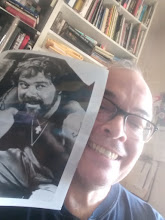
It's not just the sunglasses…

 My movie brain is a swamp where the lurid and turgid images from over a thousand movies ooze together—
Venn diagrams are intersected
and circuits are crossed
and plot-lines are scrambled.
Connections that should never meet are intertwined:
Cornucopian dream states are achieved…
Two movies that should never meet are scheduled for a double-feature in infinity… I would like to think that there is a series of tributes to
Stanley Kubrick’s 1962 adaptation of Lolita in
Magnum Force, the 1973 Ted Post-directed sequel to
Dirty Harry—
specifically in the title sequence.
Both films’
openings/title sequences are part of a unique subset of title sequences—images filmed specifically for the opening/
And like the images themselves (hands, foot) in the credits of
Magnum Force and
Lolita, they are abstracted from the whole body of the film; they are body parts.
Then the music—
yaaa-yaaa vs.
yah-yah-YAH-yahhhhh!The playful and taunting “
Theme From Lolita” has mutated into a screaming fury out for blood!
Oh Humbert, what did you
do to that poor girl?!?
Visually, they share a very similar lateral design, the screen bisected by a foot in one and a gun in the other.
This type of opening helps create a mood of another, different world—the world of the film—but unlike a
Saul Bass or
Maurice Binder title sequence, with their animated effects and Op Art graphics, don’t create a completely fantastical world.
And
Magnum Force and
Lolita’s titles are unlike simple title cards or superimposed graphics:
Since they are footage shot especially for the film, they had to be
designed and organized and approved for their respective films.
It starts with

the early-1970s Warner Bros. “wormhole” logo—
designed by graphics wizard Saul Bass, it’s my favorite logo that the company has had—
and to this day when I see the “wormhole” (which is becoming more infrequent as the company has been reediting their films to include their most recent corporate logo), I think of it as a sign that this movie will be quality—like the old
United Artists/Transamerica logo.

The bright blood red backdrop getting us amped up—
Hello,
Malpaso Company! You are another sign of quality!

Then there’s this
HUGE fuckin’ gun—it’s a
motherfuckin’ cannon!


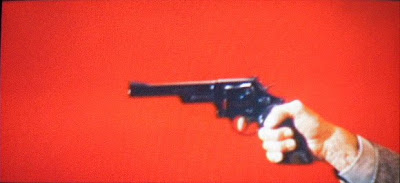


The tension is unbearable!
—And it takes forever for anything to happen!

The music is
BLARING!!

Hey! Something happened!


Then…
holy shit, that gun is pointing at
ME!


The music stops, and a modified version of Dirty Harry’s motto is heard, spoken by Eastwood, natch.
“This is a 44. Magnum,
the most powerful handgun in the world.
It can take your head clean off.
You've got to ask yourself one question,
Do I feel lucky?”
Then...
 BOOM!!!(sorry, the white flash of the gunshot schizzed out my wife’s camera….)


I’ve always been intrigued by those last few frames of the pistol flying up and back.
Why didn’t they cut away immediately after the bang?
Perhaps it is indicative of the breathing room much of the movie provides in between mayhem....
 Lolita
’s titles are the film in a nutshell:
Humbert, a slave at Lolita’s feet. The mood is languid decadence and sweaty brows.
Mmmmmm!(And you wonder: Is that Clint’s hand? Or James Mason’s? Sue Lyon’s foot?)
 Magnum Force (1973)
Directed by Ted Post
Produced by Robert Daley
Screenplay by John Milius and Michael Cimino
Story by John Milius
Based on characters and situations created by R.M. Fink and Harry Julian Fink Cinematography by Frank Stanley
Edited by Ferris Webster
Music by Lalo Schifrin
Cast: Clint Eastwood, Hal Holbrook, David Soul, Tim Matheson, Robert Urich and othersTV Guide-style synopsis: In this sequel to 1971’s Dirty Harry, the hardboiled homicide detective (Clint Eastwood) finds himself butting heads with a secret death squad operating out of his police department in this fine 1970s neo-noir conspiracy thriller.An underrated (not that
Dirty Harry fans haven’t known how good
Magnum Force is), smart 1970s neo-noir conspiracy thriller,
Magnum Force is an examination of constitutional and judicial issues hidden inside a blood-splattered, naked boobie jiggling B-movie police procedural—with a decent and 1970s conspiracy paranoia vibe I love: the enemy is within!
The often witty script is original (death squads operating in the U.S. is a freaky thought) and detailed, with a nice expansion on the “lone wolf cop” theme: he’s not just fighting the bad guys and the system, but also the corporate groupthink of the future, represented by the Hitler Youth-look-alike vigilantes.

And y’know what? There’s a difference between citizens taking the law into their own hands and the police doing the same.
Directed by the
underrated Ted Post(whose horror-thriller
The Baby is rapidly becoming quite a cult item—see it, you must!),
Magnum Force is shot in a straightforward, unobtrusive manner that has room for some stylish visuals (I love cameraman Frank Stanley’s lens flares!).
Other artistic flourishes include
Lalo Schifrin’s often overwrought but excellent score, and how the assassins are photographed, like chrome and black leather killbots.
The movie nicely balances the loud and quiet moments, and the action set-pieces still hold up, especially the ones where Clint’s doing his own stunts.
BTW, I only noticed this the last time I watched this flick, but the whole final third of the movie (from just before the raid on Palancio’s to the final showdown) takes place during the course of one day!
Compared to Callahan’s behavior and attitudes in the original
Dirty Harry (
Pauline Kael is right when she writes that we only love Harry because he’s played by the handsome Eastwood)—
and then later in
The Enforcer and
Sudden Impact(the less said of
The Dead Pool, the better),
Eastwood in
Magnum Force is a much mellower and more thoughtful dude—
still a tough cop of the old school, but hardly an A-hole.
If anything I feel that
Magnum Force is like one of Eastwood’s other, non-“Harry” cop movies, like
Tightrope or
The Gauntlet (but not
Coogan’s Bluff, where Clint’s very much the hard-nosed SOB; although the character of Harry Callahan is supposed to be San Francisco-born and bred—Russian Hill, if I’m not mistaken—I could absolutely see Coogan transferring to SF and becoming like Callahan).
 (above: some salacious scenes from Eastwood's Tightrope)
Personally, I think
Magnum Force is only a “Dirty Harry” movie in character name only—in fact, its status as a “Dirty Harry” movie might just obscure its own inherent qualities.
Honestly, with another, perhaps more emotive actor,
Magnum Force would be a “better” movie, but as is, I still love it and own a copy. And pick up the DVD with commentary by co-screenwriter (and
Dirty Harry ghostwriter—and fine director in his own right)
John Milius: it’s a hoot!
At one point in the commentary, Milius wishes death squads like the one he created for the film (which was itself inspired by police department death squads operating in Brazil in the late-1960s) were running around taking care of the financiers and bankers and brokers who have caused our most recent
Great Financial Kollapse.

(Although Milius never goes into what
Michael Cimino contributed to the screenplay; which is
interesting as Cimino went on to do the
awesome Thunderbolt & Lightfoot with Eastwood in 1974, while Milius never worked with Eastwood again despite their similar artisto-political views.)
The sign of a good paranoia/conspiracy movie is that it can comment on various ages (the machinations of the politicos in
Ken Russell’s incredible The Devils (1971;
Hey Warner Bros! How 'bout releasing that on DVD?)
can be applied to today’s abuse of eminent domain and political “witch hunts”)—
So check out
THIS weird rumor.

As a kid, I so loved the main theme from the
Magnum Force soundtrack that when I found out
WPIX Channel 11 was rebroadcasting the movie, I started planning:
I was 10 or 11 and had one of those early-1970s
Panasonic tape recorders (see image above).
My
stepdad was out somewhere, but I begged my mom not to make any noise until I sounded the all clear.
I made sure the tape wasn’t rewound all the way, and when the movie began I started taping, expertly catching the opening drum beats as they appeared over the 1970s Warner Bros. “wormhole” logo—
Except for the TV, the apartment was silent, with me holding the tape record up about an inch from the TV’s speaker.

So, the musical progression has been going well, and no extraneous noise have happened—I may have taken the phone off the hook—and neighbors nearly never called;
the credits are not that long, about 2:30, and we’re coming near the end. The music pauses for a nanosecond just before hitting the big crescendo—
And at that moment, our beloved dog,
Smash (RIP), gets off the rug and heads for the kitchen,
walking over the tile floor.
Right there on the tape that I listened to so much that after a while, the music didn’t sound right if they weren’t there—a series of click as the dog’s nails touched the tile floor in rapid succession:
Clik-clik-clik-clik!And it was timed beautifully—really, if we planned it, it couldn’t have happened better.
LALO: Dah-dun-dun-da-DAH!
DOG:
Clik-clik-clik-clik!LALO: Darra-dun!
Then, Clint’s growl (repeated for your reading pleasure):
“This is a 44. Magnum, the most powerful handgun in the world. It can take your head clean off. You've got to ask yourself one question, Do I feel lucky?”
(but no
BOOM!!!—unlike the theatrical or DVD versions, there’s no gunshot in the regular TV/edited-for-content copy of
Magnum Force—I guess the folks at home aren’t supposed to get a magnum round right in the kisser….)
(And sometimes I think I prefer the edited-for-TV version of
Magnum Force—the flick is more intense with the extreme bloodspatters removed, actually; it’s the removal of a few frames here and there that helps.)
That tape is long gone now,
but I listened to that thing for
years.
 “A man's got to know his limitations.”
I hope the Flying Maciste Brothers at the awesome, but lately infrequent (not that I’m complaining!)
Destructible Man don’t get mad about me stepping into their territory,
but there’s some good, unique dummy work in
Magnum Force:
(There’s also some lousy falling dummy work in the scene where Guzman’s naked girlfriend takes a plunge off his balcony; it looks like a department store clothing mannequin falling—so I chose to ignore it for now; beside this post is long enough!)
But the
Good Dummy Death Scene is a Beaut:
Clint’s being chased in his Plymouth Satellite by the motorcycle-cop death squad, and doesn’t have his .44 Magnum, so he can’t just pull over and simply blast them.

After performing the prerequisite 1970s car chase maneuver of
crashing through a fruit stand, Clint peels out for the China Basin, the deserted dock area where the mothball fleet (also featured in the climax of
Sam Peckinpah’s underrated The Killer Elite) is kept.

Clint manages to get ahead of the cop enough to turn the corner around a warehouse—
And then he turns
again, right back in the direction he came—
Directly at Robert Urich’s leather-clad fascist hitman!
POW!!! 


Then the film cuts to this angle of Clint-Using-Vehicle-As-Weapon, and there’s a bit of a time overlap, where we can witness the dummy getting splattered for essentially a
second time!


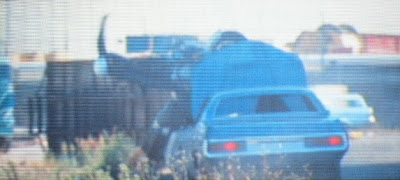


The
Mano Blanco Cops have been such arrogant pricks up to this point, that it’s really quite cathartic seeing Clint cream one of the creeps—a comforting blast of extreme and unexpected violence.
When I saw
Magnum Force for the first time—
admittedly when I was a child—but like many film geeks, I showed a precocious knowledge of genre tropes and clichés at an early age—
I was not expecting Clint-Using-Vehicle-As-Weapon, and was appropriately delighted.
I’m fascinated, though, that this tactic hasn’t been used in more films, or am I just forgetting some?
 Lolita (1962)
Directed by Stanley Kubrick
Produced by James B. Harris
Screenplay by Vladimir Nabokov, based on his novel
Cast: James Mason, Shelley Winters, Peter Sellers, Sue LyonImagine seeing
Kubrick’s Lolita in a theater in 1962?
That must’ve been
KEE-RAY-ZEE.

I think the Great Stanley K.’s
Lolita is an awesome flick—
a disturbing and stylized vision of creepy love, suitable for multiple viewings, even with the inexplicably goofy foldout bed sequence.
I think all the actors are good (
even Sue Lyon), and
Peter Sellers’ improvised monologs and speeches are priceless!
“You’re a normal kind of a guy….”(It turns out that Sellers was mimicking Kubrick himself for that voice during these segments.)
A decade ago,
It was my misfortune to be assigned to review
the remake of Lolita that had had a very troubled creation.
The review below was originally published in the November 1999
Videoscope in a different form:
Lolita (1997)
Directed by Adrian Lyne
Screenplay by Stephen Schiff
Based on the novel by Vladimir Nabakov
Cast: Jeremy Irons, Melanie Griffith, Frank Langella, Dominique Swain.It’s a measure of credit to director Adrian Lyne’s Icarus-like hubris that he even
tried adapting Vladimir Nabokov’s controversial and difficult novel,
Of course, because he chose to make his film in a more “realistic” manner than Kubrick, leaving little to the imagination (not that there’s copious amounts of nudity, but there’s slight doubt as to the nature of Lolita and Humbert’s games and relationship), casting a beautiful girl and photographing her like she was a supermodel in a perfume ad—or in one of those “classier” erotic videos that come from Europe—Lyne’s setting himself up for a fall.

Paced like molasses, the remake is joyless and humorless. Irons’ Humbert Humbert, while adequately acted with a collection of quirks, tics, twitchy, disturbing slight smiles and moody, lovelorn gazes, is nothing more than a creepy pederast.
Under Lyne’s direction, Irons is really at his most oily, reptilian and unsympathetically pathetic.

In Kubrick’s flick, Quilty is a stronger and more quickly-revealed presence: He seems to have much of the town’s female population in his aloof thrall when we first meet him, and as the film progresses, Peter Sellers and his wild and disturbing caricatures become of more and more like Humbert’s evil doppelgangers, pursuing him across the nation, whispering to him in the dark, making him more paranoid and confused.
Under Lyne, the film is a two-character play—Humbert and Lolita—and under those circumstances, the playing field is hardly even.
The character of Quilty, so essential in Kubrick’s version, is here a brief cameo—and we never learn why Quilty’s such a big hubbub to these people.
Frank Langella tries to imbue his character with a measure of sinister power and intellectualized debauchery, but he has such limited screen time that the third act denouement that “Quilty was behind it all!” comes across as a tacked-on deus ex machina.
Interruption from 2009:[And why-oh-why did we need to see Langella running nude through his house? A disgusting and disturbing image that mental bleach has yet to scour from my mind…]
End interruption from 2009James Mason’s cool urbanity, and the subtleties imposed on Kubrick via the then-reigning Production Code allowed for the creation of a Humbert whose internal pain didn’t seem like the height of morbid self-interest.
The new
Lolita’s cinematography is beautiful, but strongly points out Lyne’s background in commercials:
And when you see a beautiful girl shot under those circumstances
(and make no mistake about it, Dominique Swain is a beautiful girl (woman?), even when she wears a braces retainer—a delightfully perverse touch that increased the “ick” factor, by the way),
It comes across that this movie is exactly the type of movie that
Humbert wants to see!
Ewwwwww! 
Eastwood wasn’t the only one who’s had a good relationship with the Warner Bros. studio since the early-1970s—
Warner had an exclusive and extremely unique contract with
Stanley Kubrick since 1970, allowing him total creative control, up to and including design of a picture’s advertising campaign and the quality of the prints sent to theaters. Kubrick brought prestige and profits to the studio, and they should be commended for supporting one of the certifiable cinematic geniuses of 20th century.
In 2001, Warner Brothers released
Kubrick: A Life in Pictures, a documentary about the legendary director directed and produced by Jan Harlan, who was not only Kubrick’s executive producer on his last four films, but his brother-in-law as well.
Kubrick: A Life in Pictures (2001)
Directed by Jan Harlan.
Documentary narrated by Tom Cruise, with interviews with Christine Kubrick, Jack Nicholson, Shelley Duvall, Tom Cruise, Nicole Kidman, Peter Ustinov, Arthur C. Clarke, Michael Herr, Steven Spielberg, Woody Allen, Martin Scorsese and others.
This film is a problematic documentary that has great clips as well as valuable behind-the-scenes and home movie footage, but is also the standard hagiographical love-fest.
There’s little critical assessment, but plenty of attempts to portray
the Fab Stanley K. as a “nice guy” who loved kittens. Kubrick’s first wife is never mentioned, and Malcolm McDowell touches upon the fractiousness of his relationship with the director, but it isn’t followed up, really.
The doc tries really hard to erase all the eccentricities and rumors of weirdness that dogged the director for probably the last 30 years of his life.
But what’s so wrong with one of the greatest filmmakers in the world being eccentric?
And worst of all,
A Life in Pictures tries to gloss over the great cynicism and cold clinician’s eye he brought to all his films. If you took out all of the footage of Kubrick’s movies from this documentary, I am not sure I would know whom they were talking about.


 [Insert Introduction Here: blah-blah-blah, movies we’ve seen…./sorry we’ve been out of touch blah-blah-blah/something sarcastic, yet touchingly personal blah-blah-blah…]
 How can you not like an animated flick that has “cameos” by both Clint Eastwood and Hunter S. Thompson?
 And if Johnny Depp is anything like John Waters, the Don Knotts reference is on purpose. The “pre-heroic” Rango is a lizard clone of Mr. Knotts, down to the googly chameleon eyes.
 (Slight gripe: If Rango is a chameleon, why doesn’t he change color more? Which reminds me of the old Elaine May/Second City skit about a little girl who unfortunately kills her pet chameleon when she puts it on a checkerboard tablecloth and the critter can’t determine which color to be.)
 On the other hand, Depp, Bill Nighy and Ned Beatty really bring character to their performances, and voice-casting Harry Dean Stanton as a cantankerous blind mole was genius.

 There Will Be Blood (2007)—
 John Carpenter’s back in the saddle after far too long, and that’s all that counts.
 Dopey, dopey, very loud movie which really doesn’t need to be seen.
 I like this movie a lot. We just have to accept that the hand-held fake documentary is now an accepted subgenre, and stop complaining about Blair Witch rip-offs.
 Red (2010)—
 Run Silent Run Deep (1958)—