The National Film Board of Ivanlandia loves it some giant monster movies!
Whether from the sci-fi, fantasy or horror genres, movies about big, BIG monsters are always in heavy rotation at the Imperial Palace.
We’re really looking forward to the upcoming release of such flicks like
Monsters,
Skyline and
The Troll Hunter.
Monsters from the
Land of the Rising Sunpredominate the cinematic landscape
by sheer volume.
And Yankees get the silver medal due to so many dinosaur movies,
but our Limey cousins haven’t really been on the scene but occasionally—and then it’s something like
Konga, a flick I don’t remember liking.
But recently, out of curiosity, The National Film Board of Ivanlandia screened
Gorgo, and
WOW!
This has got to be one of the most inadvertently psychedelic flicks—on par with
Godzilla vs. the Smog Monster for bizzarro mash-up of LSD and kaiju, but more
inadvertently.
Hunter S. Thompson wrote about seeing big lizards when he was wigged out on LSD, and now here’s a movie about a big lizard that feels like it was made for people to watch while
really fucking high.
.jpg) GORGO (1961)
GORGO (1961)
After an immense underwater earthquake/volcanic explosion in the North Sea, a couple of salvage divers capture a 50-foot-tall dinosaur/monster off the coast of Ireland.
Unlike Gojira or Gamera or The Beast From 20,000 Fathoms, Gorgo wasn’t frozen or in suspended animation, but rather the Gorgosauruses lived in some sort of giant cavern
underneath the ocean floor—some strange mega-ecosystem from prehistoric times—and after the quake, the Irish waters are filled with weird, dead jurasssic-esque fish—
indicative of what the Gorgos were eating?
Or just cool stuff? Like the parasites in
Cloverfield, a monster also from the ocean floor (or
outer space, depending on whom you’re listening)?
Back to the story:
Blowing off requests from Irish museums and zoos, the divers make a very lucrative agreement with a circus-sideshow to exhibit the beast in London.


Kept in an electrified pit, the monster—now called “Gorgo” by the circus promoter (after the mythological Gorgon)—is a big hit with sell-out crowds.
But sadly, most ticket buyers aren’t there to marvel, but to jeer and sneer at a chained and shamed unique natural wonder.
Then the divers and the circus promoter get a warning: what they captured is a child—in fact, practically a newborn!
When it becomes an adult, it will be about 200 feet tall, the biologists say.
Then they realize, if this is the baby, where’s the mommy?
Meanwhile, back at the island off Ireland where the baby Gorgo was captured, a very large adult version shows up, wrecks the place, and starts following the spoor her offspring left behind.
Along the way, she trashes the British Navy, and gets to London, the town that put her little baby in a pit to be laughed at by a bunch of slobs and dumbasses.
Mommy’s not happy…


A lot of folks consider
Gorgo to be a kid’s film, and while I don’t necessarily agree, I’ll concede that it’s a point that’s hard to argue against:
First, the film presents a child-viewer surrogate in young Sean,
the 10-year-old islander who warns the divers not to disturb the beasties (but is ignored, like most kids are ignored), and
later the child-viewer stand-in becomes baby Gorgo—which ties in a young child’s feelings of persecution and helplessness, as well as body image or feelings of self-worth: “
I’m a monster.”
The child-like
perspective the film brings aids in its emotionality—you feel bad for baby Gorgo being teased, and when Mama Gorgo shows up, you cheer (and the
way Gorgo is filmed, it gives the impression that the more they shoot at Mama, the angrier she gets—like Mongo in
Blazing Saddles, “shooting only makes him angry,” and since the audience can see that—while the puny humans in the movie
can’t—we join the monsters in mocking all the attempts the grown-ups make at stop pure maternal emotionalism, which kids can tap into better than adults anyway…)
But consider this:
Since it’s a film about a mother rescuing a child, Gorgo must be looked at from a psychological perspective—
Mom saves us, but she wrecks the joint.
See, Baby Gorgo should’ve kicked ass and taken names on his own—we must break free of the apron strings!
If we keep Mommy too much in our lives, massive havoc and destruction may occur.


Originally
released in 1961, full of swirling reds and purples, and many, many crazy opticals,
this (almost forgotten) monster movie is coincidentally one of the trippier flicks I’ve seen in a long time.
A delight for fans of man-in-a-monster suit flicks, as well as appreciators of travelling matte optical work (which always leaves a shell or trail around the items being superimposed: oooo trippy!), it often feels
that Gorgo’s SPFX crew only had a very tight budget, and instead of spreading it around too much, spent it all on some wild, you-must-suspend-disbelief keiju-esque city trashing, and then spent what was left on stock footage.
I found Gorgo’s unconscious lysergicness to be much more engaging—and convincing—than the super-self-aware madcapness of the recently-released-to-DVD
Hausu (1977)—as a comparison [more on
Hausu in a moment]
Some examples:
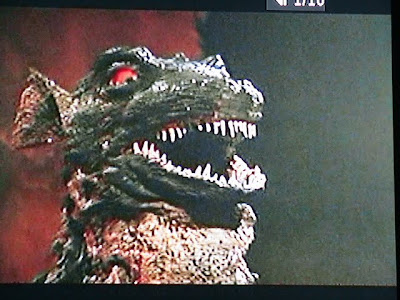
At 59:38, there’s a beautiful scene of Mama Gorgo stalking towards Big Ben, the burning and smoke behind them not smoke bombs, but optically superimposed time-lapse photography of clouds
pretending to be flames and smoke!These shots look like they should’ve been used as the cover of a rock album—but I’m not sure if Deep Purple or
Black Sabbath….But not
Blue Oyster Cult!
My screengrabs will never do it justice—and to imagine seeing this flick in an old NYC movie palace with a new print: Yow!


And maybe being psychedelisized
wasn’t an inadvertent subtext:
By 1:02:16, young Sean, the flick’s character for kids to relate to (as I already mentioned), is watching Mama Gorgo trash the joint—
and the boy has a fixed grin of rapt glee that the orange glow from the burning city only makes more LSD’ed out.
(It could also be the joy the child-surrogate feels when it is being vindicated: “SEE?!? I told you this would happen, but I’m a kid and you wouldn’t believe me! HA!)
Go
FURTHER!


Director Eugene Lourie also directed the stop-motion animation packed
The Beast From 20,000 Fathoms (1953) and
The Giant Behemoth (1959; also set in England), and created the special effects for
Crack in the World (1965) [review below] and
Krakatoa, East of Java (1969)—both of which have color palettes as lurid as Gorgo’s;
and just look at the bulbous smoke behind and around our lovely monster!


Like these other films,
Gorgo has a style that I would call Terry Gilliam-esque: design heavy, leaning very heavily towards an
anti-naturalism that I enjoy, not afraid to show its seams because it has faith that the audience will be caught up in the fantasy and suspend disbelief properly.
After all, there’s no way Lourie & Co. cannot see that their monsters and miniatures are paper mache—but their suspension of disbelief connects with their artistry, and is infectious.
I love
Gorgo!

And I just have to say that
Gorgo is much better as an exciting movie than Lourie’s previous
Beast From 20,000 Fathoms—while Beast’s FX animation, done by the incomparable Ray Harryhausen, is better than the FX of
Gorgo, there is only so much of it, and the rest of the movie is weighed down with dumb, boring dialog and stupid scenes of stupid people pretending to be scientists. Very fast-forwardable until the monster makes landfall in New York City.
In addition to some fun action and an increase in tension (monster germs?), when the Beast shows up in NYC, there is a lot of great, crisp footage of the Big Apple, especially the docks and tenements (the stuff Robert Moses—damn him!—tried to get rid of).
As for
The Giant Behemoth, it’s been ages since I’ve seen it (and I’ve got it at the top of my N-flix list; but if I’m finished with this post before it gets here, well, tough), but I remember it was a decent and spooky Big Monster flick. A vicious, radioactive brontosaurus-like beast shows up in England, causing the routine amount of mayhem—but one cool thing about the flick I remember is that the beast could project its radiation, zapping helicopters out of the sky and frying soldiers where they stand.
 Hausu (1977)
 Hausu
Hausu was a disappointment—perhaps I had been spoiled by all the pre-DVD-release hype heaped on this flicks for months beforehand.
Hausu must have been a mind-roaster for those fortunate enough to see it near or around its 1977 release, but as a spoof/riff on the haunted house genre (especially the ones by
William Castle, I feel), it does not have “legs”—and personally, I found
Hausu’s maxed-out quirkiness to be very annoying after a short time—the film (and filmmakers) are not taking their subject seriously, so why should we?
(And
Hausu isn’t funny enough to be a comedy—at least to those who do not speak fluent Japanese:
Sumimasen, nihongo wakaramasen!

It’s not that self-conscious weirdness is always a bad thing, it just needs a foundation of some sort, it has to really be about something—look at
Eraserhead, also initially released in 1977: Yes, it’s a completely self-consciously arty piece of cinematic madness.
But that weirdness is the dressing on a very personal tale of parental fear and the lack of responsibility. It’s an extremely harsh personal assessment, I feel: all the more brilliant
because it’s dressed in total id imagery. I saw
Eraserhead in 1980 when I was 15, liked it, but didn’t love it.
Now I’m an old fart, and boy-oh-boy, I get it. The film (and I) have grown.
I cannot even think that about
Hausu—a Scooby-Doo episode has more cultural relevance (and enjoyment) for me.
Hausu is about nothing except making fun of a genre that has grown and mutated far beyond what
Hausu was trying to spoof.
Hausu isn’t bad, it’s just very dated.
 Crack in the World (1965)
Recently finally released to DVD after being MIA for a long, long, long time—
I credit the
American Cinematheque in L.A. for renewing interest in this flick when they screened it in L.A. in 2007—
Crack in the World was on TV constantly when I was a kid, and I loved it then and watched the movie practically every time it was on:
Massive earthquakes! Train wrecks! Underground labs! Atomic bombs! Volcanoes! Upside-down rockets! Copious stock footage! Obvious miniatures! TOTAL FUCKIN’ DESTRUCTION!
All of it stuff a 10-year-old sci-fi nerd could fall in love with!
Crack in the World was also more ambitious than the disaster movies that followed it (this movie wasn’t going to destroy just one city or building!), and is really the grandfather to contemporary disaster movies, like
2012 and
The Core (both flicks that I enjoyed immensely!), that feature exciting, exquisitely crafted global-scale destruction--and huge gaps in logic.

That said,
Crack in the World, while still charming in its quaint mid-1960s way, has been ultimately surpassed in pacing and quality of special effects by other films (including the disaster flicks from the 1970s, like
Earthquake, and anyone who wasn’t some sort of disaster movie completist might find the flick slow and clunky.
Its greatest value may be to nostalgia buffs (and I could be one).
I’m very happy to have managed to get a copy of this film’s DVD, and every now and again use it to satiate the disaster movie monkey on my back…


.jpg)


.jpg)


.jpg)